
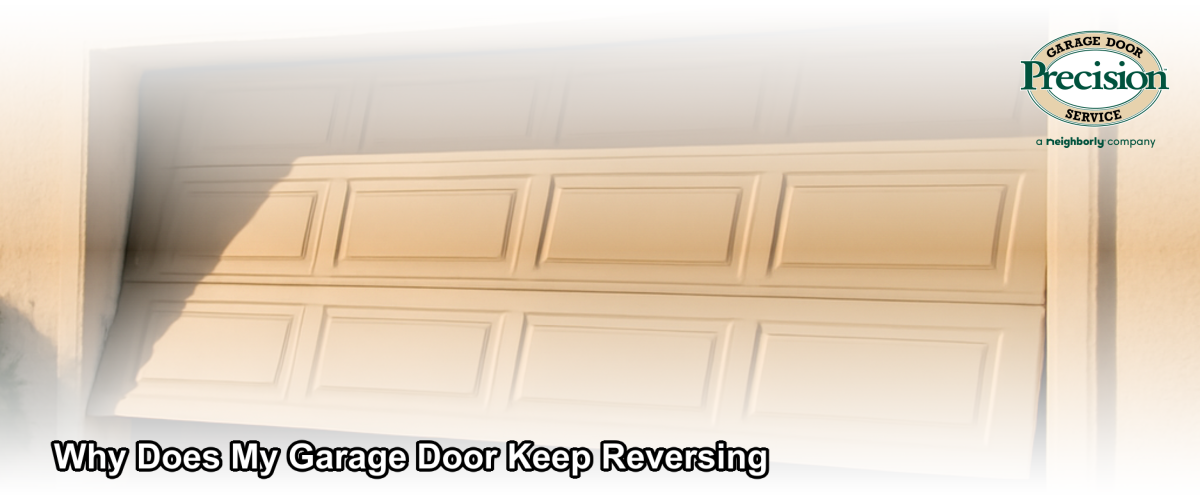
Why does my garage door reverse before it closes all the way?
A garage door that reverses before fully closing has almost always triggered one of its own built-in safety systems — either the photo-eye sensors detected an obstruction (real or phantom), or the close-force limit setting is telling the opener the door has hit resistance it shouldn’t. Both are designed to prevent the door from crushing a person, pet, or vehicle, so the reversal is the system working as intended — but something in that system is now miscalibrated or obstructed.
Precision Garage Door Ventura, serving Ventura, CA and the surrounding Ventura County coast, diagnoses this issue on a near-daily basis. The cause is almost always one of five root problems, each with a distinct fix.
Could dirty or misaligned photo-eye sensors cause my garage door to reverse?
Yes — dirty, misaligned, or sun-blinded photo-eye sensors are the single most common reason a garage door reverses unexpectedly in Ventura and throughout coastal Southern California. The two sensors sit roughly 4 to 6 inches off the ground on either side of the door opening and shoot an invisible infrared beam between them. If that beam is interrupted — by a leaf, a cobweb, direct afternoon sunlight hitting the lens, or sensors that have been bumped slightly out of alignment — the opener reads it as a blocked door and reverses to protect whatever it thinks is in the path.
Ventura’s dry, dusty summers and coastal marine layer mean sensor lenses accumulate grime faster than in many inland markets. A soft cloth wipe of both lenses takes under a minute. Alignment is checked by watching the indicator lights: one LED should glow a steady green (receiving) and one a steady amber (sending). A blinking or off light signals misalignment. Our technicians see sensor issues spike noticeably in late summer when low-angle afternoon sun hits west-facing garages directly through the door opening.
What role do the close-force and travel-limit settings play in unexpected reversal?
If the opener’s close-force setting is too sensitive, the door will reverse the moment it feels any friction — even normal weather-stripping compression — interpreting it as an obstruction. Travel-limit settings tell the opener how far down the door should travel before stopping; if that number is set too short, the door reverses before it reaches the ground because it thinks it has hit something. Both settings are adjustable via small knobs or digital controls on the opener motor unit.
In Ventura’s climate, wood garage doors are particularly prone to seasonal swelling from morning marine layer humidity, which increases the friction the door meets at the bottom seal. That added resistance can tip a borderline force setting into reversal territory. As covered in our full guide to garage door opener adjustments, force and limit settings should be checked any time a door starts behaving erratically — and recalibrated after any hardware replacement.
Can a broken or worn spring cause the door to reverse going down?
A broken torsion or extension spring dramatically increases the weight the opener must lift and lower, and most modern openers will reverse when they sense that abnormal resistance during the closing cycle. If your door reverses, feels unusually heavy when you try to move it manually, or sits unevenly in the opening, a broken spring is a strong suspect. Springs are under significant tension and should only be inspected or replaced by a trained technician — this is not a DIY repair.
Precision Garage Door Ventura’s IDEA Certified Residential Technicians carry replacement springs for the most common door weights and configurations. A spring failure that goes unaddressed doesn’t just cause reversal — it puts excess strain on the opener motor and cable drums, accelerating wear across the entire system. See our dedicated post on garage door spring replacement for cost and timing details specific to Ventura County homes.
Could the problem be with the garage door tracks or rollers?
Bent tracks, debris inside the track channel, or worn rollers create localized friction points that the opener’s force sensors read as resistance — triggering a reversal. Even a minor track gap or dent can cause the door to stutter and reverse at a specific point in its travel (always at the same height) rather than randomly. If your door consistently reverses at the same spot on the way down, a track or roller issue is the most likely explanation.
Coastal environments like Ventura accelerate roller and track wear through salt-air corrosion, especially on homes within a few miles of the Pacific. Nylon rollers tend to hold up better in salt-air conditions than standard steel ball-bearing rollers, and they run significantly quieter. Our technicians assess track straightness and roller condition as part of every service visit.
What is the manual-release cord, and could it be causing my door to reverse?
The red emergency-release cord disconnects the door from the opener carriage so the door can be operated by hand during a power outage. If this cord has been accidentally pulled — or if it was pulled and the door was never properly re-engaged to the carriage — the opener may send conflicting signals to its own logic board when it tries to move the door, which can manifest as an unexpected reversal or a door that stops and reverses mid-travel.
Re-engaging the door is straightforward: pull the release cord toward the door (not straight down), then manually lift the door until you hear the trolley carriage snap back into place. If the door still reverses after re-engagement, the issue lies elsewhere in the system.
When is an unexpected reversal a serious safety issue I should not ignore?
A garage door that reverses unexpectedly is always worth addressing promptly — but certain scenarios indicate immediate risk. If the door reverses but the safety sensors show solid, correctly colored indicator lights and nothing is blocking the beam, the opener’s logic board or wiring may be failing and the auto-reverse system cannot be trusted. A door that reverses inconsistently, or that you find you can defeat by pressing the wall button multiple times, should be treated as a safety hazard until it is professionally diagnosed.
Modern openers are required to meet UL 325 safety standards, which mandate that the door must reverse when it encounters 20 pounds or less of resistance on the closing cycle. If yours passes a manual resistance test (place a 2×4 flat on the ground under the door and close it — the door must reverse on contact) but still reverses randomly under no load, the sensor or logic system is the problem, not an overly sensitive force setting. Precision Garage Door Ventura recommends scheduling a diagnostic visit any time you cannot identify and resolve the cause yourself within one inspection cycle.
What does it typically cost to fix a garage door that keeps reversing in Ventura, CA?
Repair cost depends entirely on root cause. Sensor cleaning and realignment — the most common fix — is typically resolved during a standard service call. Limit and force adjustments are similarly low-cost when done as part of a diagnostic visit. Spring replacement in Ventura generally ranges from $150 to $350 depending on spring type (torsion vs. extension) and door weight. Roller replacement runs roughly $100 to $200 for a full set. Logic board or opener replacement, the costliest scenario, can range from $200 to $500+ depending on the brand and whether the full opener unit needs to go.
Hidden costs to watch for: if a reversal caused by a failing spring went unaddressed for months, the opener motor may show premature wear and need replacement alongside the spring. Bundling repairs in a single visit avoids a second trip charge. Precision Garage Door Ventura’s IDEA Certified Residential Technicians provide a written diagnosis before any work begins so there are no surprises on the final invoice.
This guide was prepared by Precision Garage Door Ventura’s IDEA Certified Residential Technicians, serving Ventura, CA and communities throughout Ventura County.
Frequently Asked Questions
Why does my garage door go down a few feet and then reverse?
A door that reverses consistently at the same point in its travel almost always has a friction problem at that location — a bent track, worn roller, or debris in the track channel. If it reverses randomly at different heights, the photo-eye sensors or close-force settings are the more likely culprit.
How do I tell if my garage door sensors are the reason it keeps reversing?
Check the two small sensor units mounted near the floor on each side of the door frame. The sending unit should show a steady amber light and the receiving unit a steady green light. Any blinking or absent light means the beam is broken or the sensors are misaligned — clean the lenses with a soft cloth and gently adjust the sensor bracket until both lights glow solid.
Is it safe to keep using a garage door that reverses unexpectedly?
It depends on the cause. If you can identify and resolve the issue — such as a dirty sensor — normal use can resume. If the reversal is random, cannot be explained, or the door fails to reverse when you place a physical object under it, stop using the opener and call a technician. An unpredictable auto-reverse system is a safety hazard.
Can I fix a reversing garage door myself, or do I need a professional?
Sensor cleaning, sensor realignment, and opener limit or force adjustments are reasonable DIY steps a careful homeowner can try first. Anything involving springs, cables, or the opener’s internal wiring should be handled by a certified technician — springs in particular are under extreme tension and can cause serious injury if mishandled.
How much does it cost to repair a garage door that keeps reversing in Ventura?
Simple fixes like sensor adjustment are typically covered under a standard service call fee. Spring replacement in Ventura runs roughly $150 to $350, roller replacement around $100 to $200, and opener or logic board replacement $200 to $500 or more depending on the unit. A diagnostic visit with a written estimate before work begins is the best way to know exactly what you’re facing.