
What do garage door hinges actually do, and why does their condition matter?
Garage door hinges connect each panel of your door together and allow the sections to bend and flex as the door travels up and down the track. Without functioning hinges, the panels cannot pivot correctly — leading to binding, noise, misalignment, and eventually a door that will not open or close safely.
Most residential garage doors have between 10 and 18 hinges depending on the number of panels and door height. Each hinge flexes hundreds of times per year, making them one of the highest-wear components on the entire system. Keeping them in good condition is one of the simplest and most cost-effective things a homeowner can do.
How often should garage door hinges be inspected in Ventura, CA?
Hinges on a Ventura-area garage door should be visually inspected at least twice per year — once in the fall before cooler, damper months and once in the spring. Ventura County’s coastal air introduces salt and moisture that accelerates surface corrosion on steel hinges faster than you would see in a dry inland climate.
During each inspection, look for rust spots, cracks at the mounting holes, bent flanges, or rollers that no longer spin freely inside the hinge barrel. Any of these signs indicate the hinge is already under stress. Catching the problem early is always cheaper than waiting for a hinge to fail mid-operation — a point the IDEA Certified Residential Technicians at Precision Garage Door Ventura reinforce on every service call.
What is the right way to lubricate garage door hinges?
The correct lubricant for garage door hinges is a dedicated garage door lubricant or white lithium grease — never WD-40, which is a solvent and degreaser that strips protective coatings and attracts dirt over time.
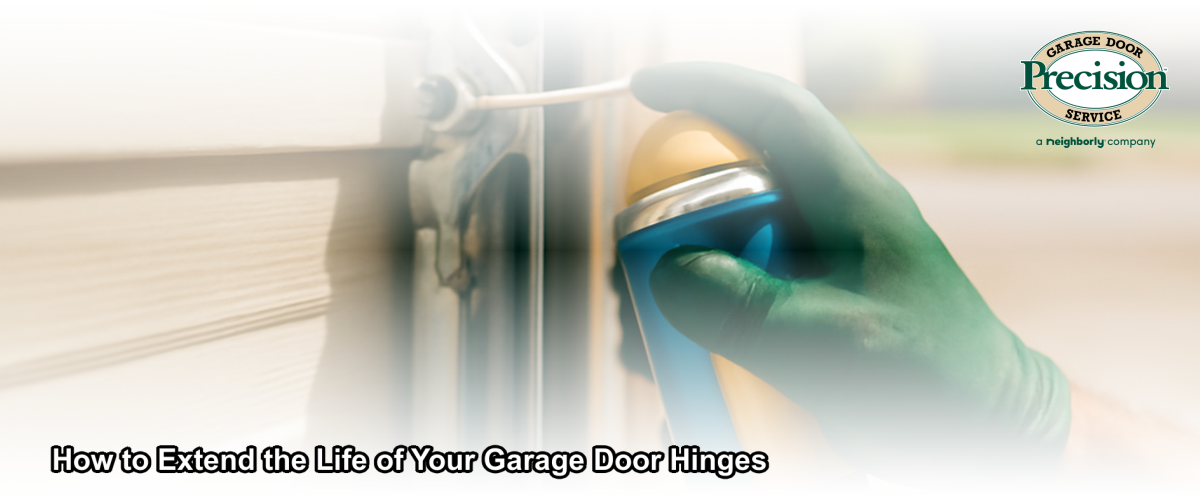
Apply lubricant to the pivot points and the roller stem inside the hinge barrel, not to the face of the hinge plate. Here is the correct sequence:
- Open the door fully so the hinges are relaxed and accessible.
- Wipe each hinge with a dry cloth to remove grit and old lubricant residue.
- Apply a small amount of white lithium grease or garage door lubricant to the hinge pin and roller stem.
- Cycle the door manually two or three times to work the lubricant into the joint.
- Wipe away any excess to keep the door clean and prevent dirt accumulation.
This process takes under 20 minutes and, done consistently every 6 months, can meaningfully extend hinge life and reduce noise — a quick win that costs almost nothing in materials.
What are the hidden costs of ignoring worn garage door hinges?
A single failing hinge rarely stays a single problem. When one hinge cracks or bends, it transfers extra lateral load to adjacent hinges and to the track system, accelerating wear across the entire door.
What starts as a $15–$30 hinge replacement can become a much larger repair if the problem is ignored long enough to damage rollers, bend a track section, or crack a panel. At Precision Garage Door of Southern California, the standard diagnostic service call is $69.95, and labor is billed at $190 per hour — catching a hinge problem early during a routine inspection costs far less than a hardware overhaul or panel replacement. Financing through Synchrony is available for larger repairs when needed, but the goal of regular maintenance is to avoid reaching that point.
See our related maintenance guide on garage door roller care for a complete picture of how hinges, rollers, and tracks interact as a system.
Can I replace a garage door hinge myself, or should I call a professional?
Replacing a standard mid-panel hinge — the hinges that join two door sections in the middle of the door — is a manageable DIY task for a careful homeowner, provided the door’s springs are fully operational and the door is in the up position (fully open and resting on the horizontal track).
However, hinges located at the bottom of the door — called bottom brackets — are directly attached to the cable and spring system. These are under high tension and must never be removed or adjusted by anyone who is not a trained technician. Attempting to service bottom brackets without professional training is a documented cause of serious injury. The IDEA Certified Residential Technicians at Precision Garage Door Ventura handle bottom bracket work as part of every hardware overhaul and 25-point safety inspection — do not treat these as a DIY job.
What type of hinges are used on residential garage doors, and does the material matter?
Residential garage door hinges are stamped from steel and graded by gauge — the lower the gauge number, the thicker and stronger the steel. Standard builder-grade hinges are typically 14-gauge, while heavy-duty replacements used on commercial-style residential doors run 11-gauge or thicker.
In Ventura’s coastal environment, galvanized or zinc-plated hinges hold up significantly better than bare steel because they resist the salt-air corrosion that shortens hinge life near the Pacific. When Precision Garage Door of Southern California replaces hinges in Ventura, Oxnard, or the broader Ventura County service area, technicians select hardware rated for the local climate conditions rather than defaulting to the lightest option available.
How do I know when my garage door hinges need to be replaced rather than just lubricated?
A hinge that needs replacement — not just lubrication — will show one or more of the following: a visible crack or split in the steel flange, elongated or torn mounting holes that allow the hinge to rock on the bolt, a bent or twisted body that prevents flat contact with the panel, or a roller that is seized and no longer rotates inside the hinge barrel.
Squealing or grinding that persists after proper lubrication is also a reliable indicator that the hinge barrel is worn beyond its serviceable tolerance. At that point, continued operation accelerates damage to the surrounding panel and track. Precision Garage Door of Southern California’s 25-point safety inspection covers every hinge on the door and gives homeowners a clear, written picture of what needs attention now versus what can wait — no guesswork required.
Does Precision Garage Door Ventura service all major garage door brands?
Yes — Precision Garage Door of Southern California services and repairs all major garage door brands, regardless of who originally installed the door. The team serves Ventura, Oxnard, Camarillo, Thousand Oaks, Moorpark, Santa Barbara, and all of Ventura County from the local office at 2734 Johnson Dr #202, Ventura, CA 93003.
Same-day service is available 7 days a week, with evening and weekend appointments at no extra charge. All work is guaranteed, and California State Contractor’s License #993555 covers every job. Calls are answered by a live operator 24/7 — there is no automated system blocking access to help when a door fails unexpectedly.
This guide was prepared by Precision Garage Door of Southern California’s IDEA Certified Residential Technicians, serving Ventura, CA and all of Ventura County.
Frequently Asked Questions
How often should I lubricate my garage door hinges?
Lubricate garage door hinges every 6 months using white lithium grease or a dedicated garage door lubricant — never WD-40. In coastal areas like Ventura, CA, where salt air accelerates corrosion, sticking to a twice-yearly schedule makes a measurable difference in hinge lifespan.
What are the signs that garage door hinges need to be replaced?
Replace hinges when you see cracked or split steel, elongated mounting holes, a bent hinge body, or a roller that no longer spins inside the barrel. Squealing or grinding that continues after lubrication is also a reliable sign the hinge has worn past its serviceable life.
Is it safe to replace garage door hinges myself?
Mid-panel hinges can be replaced by a careful homeowner when the door is fully open and spring tension is not involved. Bottom bracket hinges — which connect directly to the cable and spring system — must only be serviced by a trained professional, as they are under extreme tension and are a documented source of serious injury.
How much does it cost to have a professional inspect or replace garage door hinges in Ventura, CA?
Precision Garage Door of Southern California charges a $69.95 diagnostic service call and a $190 per hour labor rate. A hinge inspection is typically included in the 25-point safety inspection, and individual hinge replacements during a service visit are handled at the same labor rate — catching problems early is almost always less expensive than waiting for a failure.
What type of lubricant should I use on garage door hinges?
Use white lithium grease or a product specifically labeled for garage doors. Apply it to the hinge pin and roller stem — not the flat face of the plate. Avoid WD-40, which acts as a solvent, strips protective coatings, and attracts dirt that accelerates wear.