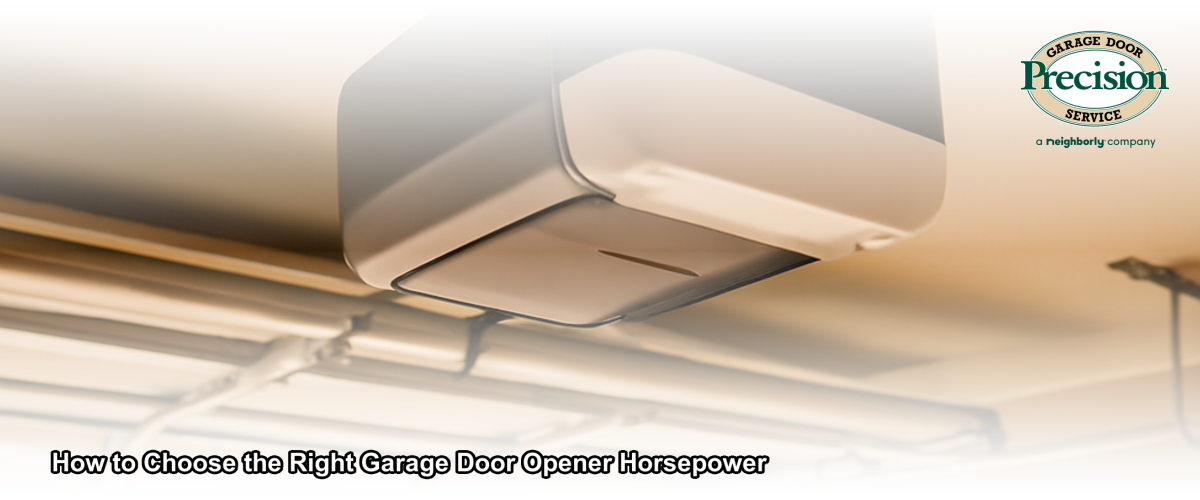
What horsepower do I need for a garage door opener?
Most residential garage doors work well with a 1/2 horsepower (HP) opener, but heavier doors — including solid wood doors, two-car doors over 14 feet wide, or insulated steel doors above 300 lbs — require 3/4 HP or 1 HP to operate safely and reliably. Choosing the wrong motor size strains the drivetrain, shortens the opener’s lifespan, and can void your warranty.
At Precision Garage Door Ventura, our IDEA Certified Residential Technicians assess door weight, height, and daily cycle demands before recommending a motor — not the other way around. The sections below walk through every factor that matters.
What is the difference between 1/2 HP, 3/4 HP, and 1 HP garage door openers?
The three standard residential horsepower ratings correspond to progressively heavier lifting capacity and faster recovery between cycles, not just raw speed.
- 1/2 HP — Suitable for single-car doors and lightweight double doors (hollow-core steel, aluminum). Handles doors up to roughly 200–250 lbs.
- 3/4 HP — The most versatile residential option. Handles insulated steel doors, heavier double doors, and doors up to 300–400 lbs. Recommended for most two-car garages.
- 1 HP — Designed for solid wood carriage-house doors, oversized doors taller than 8 feet, or any application where the door exceeds 400 lbs. Also the right choice for commercial-adjacent residential use with 10+ daily cycles.
Note that horsepower ratings are not standardized identically across every brand — a 3/4 HP unit from one manufacturer may outperform a 1 HP unit from another. Our technicians at Precision Garage Door Ventura evaluate peak torque and duty cycle ratings alongside the HP label when making recommendations.
Does my garage door’s weight and material affect which opener I need?
Yes — door weight is the single most important variable in choosing opener horsepower, and material determines weight more than any other factor.
Here is a practical reference by door type:
- Single steel door (non-insulated), 9 ft wide: typically 90–130 lbs — a 1/2 HP opener is sufficient.
- Double steel door (non-insulated), 16 ft wide: typically 150–200 lbs — a 1/2 HP opener can work, but 3/4 HP is recommended for longevity.
- Double insulated steel door, 16 ft wide: typically 200–300 lbs — 3/4 HP is the minimum; 1 HP if the door is also taller than 8 ft.
- Solid wood carriage-house door, 16 ft wide: typically 350–500 lbs — 1 HP is required.
If you have added insulation to an existing door or upgraded to a heavier decorative overlay, your current opener may be undersized even if it was correctly specified at installation. See our related guide on garage door spring tension for how door weight interacts with the full mechanical system.
Does Ventura’s coastal climate affect garage door opener performance?
It does — and this is one of the most overlooked factors for homeowners in Ventura, CA. Salt air from the Pacific coastline accelerates corrosion on torsion springs, rollers, and tracks, which adds friction to the door’s travel path and effectively increases the load your opener must overcome.
A door that weighed 200 lbs when installed may place the mechanical equivalent of a 250-lb load on an opener after two or three years of salt-air exposure if the hardware has not been regularly lubricated and inspected. This is a strong argument for sizing up — choosing 3/4 HP over 1/2 HP — for any home within a few miles of the Ventura shoreline or the Channel Islands Harbor area.
Humidity-driven wood swelling is also relevant for homeowners with real-wood doors, which can gain meaningful weight seasonally. Precision Garage Door Ventura’s IDEA Certified Residential Technicians factor in local environmental conditions as part of every opener recommendation.
What drive type should I pair with my chosen horsepower level?
Horsepower determines how much your opener can lift; drive type determines how it lifts — and the two choices interact in ways that matter for noise, maintenance, and long-term cost.
- Chain drive: The most affordable and most durable option. Pairs well with 3/4 HP or 1 HP for heavy doors. Louder than belt drive — less ideal if a bedroom is directly above the garage.
- Belt drive: Quieter and smoother than chain. Available in 1/2 HP, 3/4 HP, and 1 HP. The preferred pairing for attached garages in residential neighborhoods where noise matters.
- Screw drive: Fewer moving parts, moderate noise level. Works well in climates with stable temperatures — less ideal in coastal environments where humidity swings can affect the rail lubrication.
- Direct drive (jackshaft): Mounts beside the door rather than overhead. An excellent choice for high-ceiling or low-headroom garages common in older Ventura homes. Available in 3/4 HP and 1 HP configurations.
As a general rule: match a quieter drive type (belt or direct drive) with the minimum adequate horsepower for your door weight, rather than over-specing the motor to compensate for a noisy or inefficient drive system.
What hidden costs or extras should I expect with an opener installation?
The opener unit itself is only part of the total investment. A full professional installation in Ventura, CA typically includes the following line items worth understanding before you commit:
- Spring inspection and adjustment: If your torsion or extension springs are not balanced to the new opener’s torque output, the motor will be fighting the spring — expect this to be flagged during any professional install.
- New safety sensors: Required by California code if the existing sensors are more than a certain age or if the opener being replaced predates modern UL 325 safety standards.
- Keypad, remote, and app module: Many modern openers are sold as base units; WiFi connectivity, extra remotes, and exterior keypads are often sold separately. Confirm what is included in your quoted package.
- Wiring and outlet work: Older garages in Ventura — particularly those in neighborhoods with homes built in the 1960s–1980s — sometimes lack a properly grounded ceiling outlet within reach of the opener rail. An electrical rough-in adds cost but is non-negotiable for safe installation.
- Haul-away of old unit: Confirm whether your installer includes removal and disposal of the existing opener.
Precision Garage Door Ventura provides itemized quotes before any work begins so there are no line items that appear only on the final invoice.
Can I install a higher-horsepower opener than I need, just to be safe?
Over-sizing a garage door opener is generally harmless to the door itself but offers no meaningful benefit and adds unnecessary upfront cost — a 1 HP opener on a 130-lb single door will not open faster or last longer than a correctly sized 1/2 HP unit on the same door. What matters far more than peak horsepower is that the motor’s duty cycle rating matches your actual daily usage, that the drive type suits your environment, and that the springs are properly balanced.
Where slightly over-sizing does make sense: if you plan to add insulation to your current door within the next few years, sizing up now avoids replacing the opener again later. Our IDEA Certified Residential Technicians at Precision Garage Door Ventura can walk you through a forward-looking recommendation based on any planned door upgrades.
When is the right time to replace an existing garage door opener?
Most residential garage door openers have a useful service life of 10–15 years with routine maintenance; openers installed before 2011 may not meet current UL 325 auto-reverse safety standards required in California and should be evaluated for replacement regardless of whether they still function.
Signs that your current opener is undersized — rather than simply worn out — include: the motor running hot after a single cycle, the door reversing unexpectedly on cold mornings (a sign the motor is hitting its torque limit), or the opener struggling noticeably on a door that has never changed. These symptoms point to a horsepower mismatch, not just age. For a full checklist of failure signs, see our related guide to garage door opener troubleshooting.
This guide was prepared by Precision Garage Door Ventura’s IDEA Certified Residential Technicians, serving Ventura, CA and the surrounding communities along the Ventura County coast.
Frequently Asked Questions
What horsepower garage door opener do I need for a two-car garage?
Most two-car garage doors need at least a 3/4 HP opener. If the door is insulated, solid wood, or taller than 8 feet, step up to 1 HP. A 1/2 HP unit is typically only adequate for lightweight single-car doors.
Is a 1/2 HP garage door opener strong enough for a heavy door?
A 1/2 HP opener is designed for doors up to roughly 200–250 lbs. If your door exceeds that — common with insulated steel or solid wood doors — a 1/2 HP motor will overheat, wear faster, and may fail prematurely. Size up to 3/4 HP or 1 HP for heavier doors.
Does salt air near the Ventura coast affect my garage door opener?
Yes. Salt air corrodes springs, rollers, and tracks over time, adding friction that makes your opener work harder than its rated load. Ventura homeowners near the coast should consider sizing up one horsepower level and scheduling annual lubrication inspections to offset this wear.
How long does a residential garage door opener last?
A properly sized and maintained garage door opener typically lasts 10–15 years. Openers installed before 2011 may not meet current California UL 325 safety standards and should be inspected for replacement even if still operational.
Does a higher horsepower opener make my garage door open faster?
No — opener speed is set by the drive system and motor RPM, not the horsepower rating alone. Over-sizing the HP adds cost without improving speed or longevity on a correctly balanced door. Choose the minimum adequate horsepower for your door’s actual weight and daily cycle count.