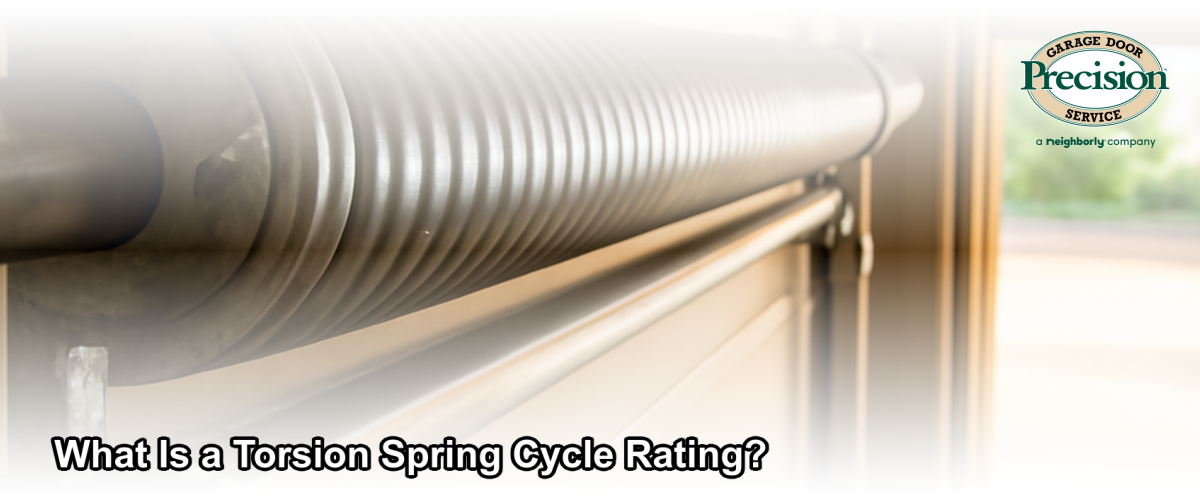
What is a garage door torsion spring cycle rating?
A garage door torsion spring cycle rating is the number of open-and-close cycles a spring is engineered and tested to complete before it is likely to fail. One cycle equals one full opening plus one full closing of the door. This number is stamped or specified by the manufacturer and is the single most important factor in predicting how long your springs will last before they need to be replaced.
Most standard torsion springs sold with entry-level garage doors carry a rating of 10,000 cycles. High-cycle upgrades are available at 25,000, 50,000, and even 100,000 cycles — each tier representing a meaningfully longer service life and a different wire gauge and coil design built to handle the added stress.
How many years does a 10,000-cycle torsion spring last in Ventura, CA?
A 10,000-cycle torsion spring on an average Ventura-area household lasts roughly 7 to 9 years, assuming the garage door is used about three to four times per day — which works out to approximately 1,200 to 1,500 cycles per year. Households with more vehicles, teenagers, or home-based businesses will exhaust that rating faster.
Ventura’s coastal climate adds a variable that inland homeowners do not face. Salt air and marine humidity — especially in neighborhoods closer to the Channel Islands Harbor and the Ventura Pier — accelerate metal fatigue and surface corrosion on standard spring wire. A spring that might reach its full rated life in a dry inland area like Palmdale or Lancaster may degrade noticeably faster here. Routine lubrication with a quality garage door lubricant (not WD-40) is one of the simplest ways to slow that process; see our maintenance guide for a full lubrication schedule.
What is the difference between a standard spring and a high-cycle torsion spring?
A high-cycle torsion spring uses a thicker wire gauge and tighter tolerances than a standard spring, which allows it to flex through many more cycles before the metal fatigues and breaks. The core materials are the same — tempered steel — but the engineering specifications are substantially different, and that difference is reflected in a longer rated service life and a higher upfront cost.
At Precision Garage Door of Southern California, our IDEA Certified Residential Technicians can measure your existing spring’s wire diameter, inside diameter, and length on-site during a service visit to identify the exact replacement specification — and to recommend whether a standard or high-cycle upgrade makes sense for your usage pattern. A standard service call in Ventura carries a $69.95 diagnostic fee, and labor is billed at $190 per hour.
Is a higher cycle rating worth the extra cost?
For most Ventura households, upgrading to at least a 25,000-cycle torsion spring is worth the additional investment because the cost difference between a standard and high-cycle spring is small relative to the labor cost of a repeat replacement. When you factor in our $190/hour labor rate and the inconvenience of a broken spring — which can leave your vehicle trapped inside — paying more once for a longer-lasting component is straightforward math.
Homeowners who use their garage as a primary entry point (multiple trips per day), run a home business out of their garage, or live in the salt-air microclimate near the Ventura coast will see the most benefit. A 50,000-cycle spring could represent more than 30 years of service for a single-car household using the door twice a day. For a busy four-car family, that same spring might last 10 to 12 years — still a meaningful upgrade over a standard spring.
What happens when a torsion spring reaches the end of its cycle life?
When a torsion spring exhausts its cycle rating, the coils lose their ability to store and release tension evenly, and the spring typically snaps — often with a loud bang. A broken torsion spring means the garage door will not open, because the spring counterbalances the full weight of the door, which can range from 100 to over 400 pounds depending on material and insulation. Attempting to force the door open manually or through the opener motor risks damaging the opener, cables, and track hardware.
Precision Garage Door of Southern California offers same-day spring replacement service across Ventura, Oxnard, Moorpark, Camarillo, and throughout Ventura County. Our office is open seven days a week with live-operator call answering available 24/7 — and evening and weekend appointments are available at no extra charge.
Can I replace a torsion spring myself?
Torsion spring replacement is one of the most hazardous DIY garage door tasks and is strongly discouraged for homeowners without specialized training. A torsion spring stores a significant amount of mechanical energy under extreme tension — enough to cause serious injury or death if the spring releases suddenly during winding or unwinding. The tools required (winding bars, a torque wrench, and precise knowledge of the correct number of turns for your door’s weight and height) are not standard household equipment.
California State Contractor’s License #993555 covers Precision Garage Door of Southern California’s service technicians, all of whom complete months of classroom and on-road training before working independently. Our IDEA Certified Residential Technicians also conduct a 25-point safety inspection with every service visit — so a spring replacement is an opportunity to catch worn cables, fraying hardware, or misaligned tracks before they become separate, more expensive failures. As with any high-risk repair, the labor cost of a licensed professional is not a luxury; it is the protection you are paying for.
What else is included — and what are the hidden costs — of a torsion spring replacement?
Transparency about the full scope of a repair is something Precision Garage Door of Southern California takes seriously. Here is what to expect when you schedule a spring replacement in Ventura:
- $69.95 diagnostic/service call fee — covers the technician’s visit and the 25-point safety inspection regardless of whether you proceed with the repair.
- $190/hour labor rate — most standard torsion spring replacements on a single-spring system are completed in under an hour by an experienced technician; dual-spring systems take longer.
- Parts cost — the spring itself varies by size, wire gauge, and cycle rating. A standard 10,000-cycle spring costs less than a 50,000-cycle high-cycle spring; your technician will quote both options so you can choose.
- Cable inspection and possible replacement — cables and springs wear together. If the cables show fraying or uneven wear, replacing them at the same visit avoids a separate labor charge later.
- No extra charge for evenings or weekends — unlike many competitors, Precision Garage Door of Southern California does not apply a surcharge for after-hours or weekend appointments.
Financing for both repairs and new installations is available through Synchrony — applications are fast and straightforward. Call (805) 206-2434 for current terms.
How do I know what cycle rating my current torsion spring has?
The cycle rating of your current spring is rarely printed on the coil itself, but a trained technician can determine the specification by measuring the wire diameter, inside diameter, and length of the spring — then cross-referencing those measurements with manufacturer data. Most springs installed with builder-grade or entry-level doors default to the 10,000-cycle standard. If your door came with the house and you have lived there for more than seven or eight years, there is a reasonable chance the spring is already approaching or past its rated life even if it has not broken yet.
If you are unsure, Precision Garage Door of Southern California’s technicians serving Ventura, CA and surrounding Ventura County communities can identify your spring specification during a scheduled service visit and give you a clear, written estimate for any recommended replacement — with no pressure to decide on the spot.
This guide was prepared by Precision Garage Door of Southern California’s IDEA Certified Residential Technicians, serving Ventura, CA and communities throughout Ventura County, the Western San Fernando Valley, and Santa Barbara.
Frequently Asked Questions
What does a torsion spring cycle rating mean on a garage door?
A cycle rating is the total number of open-and-close cycles a torsion spring is manufactured to complete before it is expected to fail. One cycle equals one full opening plus one full closing. Standard springs are rated at 10,000 cycles; high-cycle options go up to 25,000, 50,000, or 100,000 cycles.
How long does a 10,000-cycle garage door spring last?
At an average usage rate of three to four door cycles per day, a 10,000-cycle torsion spring lasts roughly 7 to 9 years. Heavier usage or coastal salt-air exposure — common in Ventura, CA — can shorten that lifespan.
Is it worth upgrading to a high-cycle torsion spring?
Yes, for most homeowners. The upfront cost difference between a standard and high-cycle spring is small compared to the labor cost of a repeat replacement. Households that use their garage door frequently or live near the coast benefit most from a 25,000- or 50,000-cycle upgrade.
Can a homeowner replace a torsion spring without a professional?
It is not recommended. Torsion springs are under extreme mechanical tension and can cause serious injury if mishandled during winding or unwinding. Licensed technicians with proper tools and training — like the IDEA Certified Residential Technicians at Precision Garage Door of Southern California — should perform this repair.
How much does torsion spring replacement cost in Ventura, CA?
Expect a $69.95 service call fee plus $190 per hour in labor. The spring itself varies in price by size and cycle rating. Evening and weekend appointments are available at no extra charge. Financing through Synchrony is also available for qualifying repairs.