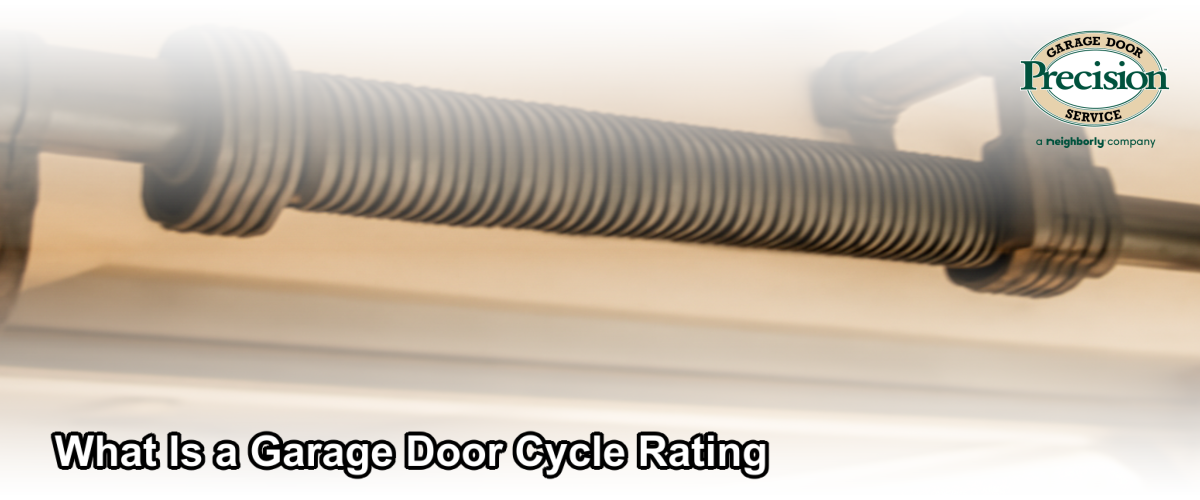
What is a garage door cycle rating?
A garage door cycle rating is the number of open-and-close operations a specific component — most often the springs — is engineered and tested to complete before it is likely to fail. One full cycle equals one open plus one close. When a spring is rated for 10,000 cycles, that means it has been designed and tested to reliably perform 10,000 complete trips up and down before the metal fatigue risk becomes significant.
Cycle ratings are not a vague marketing claim — they are rooted in standardized fatigue testing on the spring wire itself. Every major component on your door (springs, cables, rollers, hinges) carries an implied or stated cycle life, and the weakest link determines how soon you will need service.
How many garage door cycles does the average Ventura household use per year?
Most households in Ventura, CA average 3 to 5 door cycles per day, which works out to roughly 1,000 to 1,500 cycles per year. A family with multiple drivers — common in Ventura’s commuter neighborhoods where residents travel the 101 or the 126 daily — can easily reach 6 to 8 cycles per day, pushing annual use closer to 2,000 cycles.
Those numbers matter because they translate directly into how long your springs will last. At 1,500 cycles per year, a standard 10,000-cycle spring lasts roughly 6 to 7 years. At 2,000 cycles per year, that same spring may reach end-of-life in as few as 5 years.
What is the difference between a standard and a high-cycle garage door spring?
Standard residential torsion springs typically carry a rating of 10,000 cycles, while high-cycle springs are available in ratings of 25,000, 50,000, or even 100,000 cycles — a meaningful difference for any household that uses the garage as a primary entry point. High-cycle springs use a heavier-gauge wire wound to tighter tolerances, which distributes stress more evenly across the coil with every operation.
The cost difference is real but modest compared to the labor savings over time. Upgrading from a 10,000-cycle spring to a 25,000-cycle spring at the time of installation typically adds a relatively small amount to the upfront cost, but can cut the number of spring replacements you need over a 20-year ownership period from three or four down to one. As covered in our guide to garage door spring replacement, the labor cost of a service visit often exceeds the cost of the spring itself — so fewer visits means real savings.
Does Ventura’s coastal climate affect how quickly a garage door reaches its cycle limit?
Ventura’s marine layer, salt air off the Pacific, and seasonal moisture swings do not change the cycle count itself, but they absolutely affect how much of the rated life a spring actually delivers in practice. Salt-laden air accelerates surface corrosion on uncoated spring wire, creating micro-pitting that becomes a stress concentration point — meaning a spring may snap well before it reaches its rated cycle count if it has not been properly maintained or if it was not manufactured with a protective coating.
Homes within a few miles of Ventura’s coastline — including areas near the Ventura Harbor and the beachfront neighborhoods along Pacific Coast Highway — are at the highest risk of accelerated spring wear. Precision Garage Door Ventura’s IDEA Certified Residential Technicians recommend opting for galvanized or coated high-cycle springs in any coastal installation, and scheduling a lubrication and inspection service at least once per year to displace moisture and catch early corrosion before it shortens spring life.
Do cycle ratings apply to the whole garage door or just the springs?
Cycle ratings technically apply to individual components, not to the door system as a whole — and springs are not the only parts with a finite cycle life. Rollers, cables, and hinges all have expected service windows measured in cycles, and they do not all align with one another, which is why a thorough inspection looks at every moving part, not just the springs.
- Springs: Standard residential torsion springs are rated 10,000 cycles; high-cycle options extend to 25,000–100,000 cycles.
- Nylon rollers: Quality nylon rollers typically last 10,000–12,000 cycles; steel rollers can last longer but create more noise.
- Cables: Galvanized lift cables are generally rated for the life of the spring but should be inspected at every spring service — fraying is a safety hazard regardless of cycle count.
- Hinges: Heavy-duty steel hinges are rarely the limiting factor, but cheaper stamped-steel hinges can crack at high cycle counts, especially under the stress of an out-of-balance door.
When Precision Garage Door Ventura installs or replaces components, our technicians assess cycle ratings across the full system so that a high-cycle spring is not undermined by rollers or cables that will fail years earlier.
What happens when a garage door spring exceeds its cycle rating?
When a spring surpasses its rated cycle life, the likelihood of a sudden, complete break increases sharply — and a broken torsion spring is one of the most disruptive failures a garage door can experience. The door becomes effectively inoperable: most modern doors with a broken spring are too heavy for the opener to lift safely, and attempting to force the door open can damage the opener motor, bend the door tracks, or create a safety hazard for anyone near the door.
Unlike a slow drip from a failing faucet, spring failure tends to be instantaneous. Many homeowners discover a broken spring in the morning when they cannot get their car out for a commute. Replacing springs proactively — before the rated cycle count is reached — eliminates that risk entirely. See our related post on warning signs your garage door spring is failing for the early indicators to watch for between scheduled inspections.
What hidden costs or extras should I expect when upgrading to high-cycle springs?
When upgrading springs at Precision Garage Door Ventura, the core cost is the spring hardware itself plus the technician’s labor to safely wind the new spring to the correct tension for your door’s weight and size — a process that requires specialized tools and IDEA Certified training to perform without risk of injury. There are a few additional factors that can affect the total:
- Cable replacement: If your existing lift cables show fraying or corrosion, technicians will recommend replacing them at the same visit — combining labor saves money versus a separate call.
- Bearing plates and center bracket: Worn bearing plates create friction that shortens spring life regardless of cycle rating; replacing them when upgrading springs is a cost-efficient decision.
- Balancing and adjustment: After new springs are installed, the door must be balanced to confirm even lift — this is included in a professional spring replacement, not an add-on.
- Lubrication service: A full lubrication of all moving parts is standard at the time of spring installation, particularly important given Ventura’s coastal air exposure.
Transparency about total job scope before any work begins is a core part of how Precision Garage Door Ventura operates — no technician will begin a spring replacement without reviewing all findings with the homeowner first.
Is it worth upgrading to high-cycle springs when replacing a garage door opener?
Yes — an opener replacement is one of the best moments to upgrade your springs, because the labor for spring inspection and replacement is already partially overlapping with the opener installation work. Pairing a new belt-drive or direct-drive opener with high-cycle springs gives you a mechanically matched system: the opener’s rated cycle life (typically 10,000 to 15,000 cycles for a quality residential unit) will align more closely with your spring life, reducing the chance that one component outlasts the other by a wide margin.
Precision Garage Door Ventura’s IDEA Certified Residential Technicians routinely recommend this coordinated approach for homeowners in Ventura and the surrounding areas, particularly those planning to stay in their homes for 10 or more years — the long-term cost of fewer service calls typically offsets the modest upfront premium of high-cycle components within the first replacement cycle.
This guide was prepared by Precision Garage Door Ventura’s IDEA Certified Residential Technicians, serving Ventura, CA and the surrounding Ventura County communities.
Frequently Asked Questions
How long do garage door springs last in Ventura, CA?
In Ventura, CA, most standard 10,000-cycle springs last 5 to 7 years based on typical household usage of 3 to 5 cycles per day. Coastal salt air can shorten that lifespan if springs are not properly lubricated and inspected annually. High-cycle springs rated for 25,000 or more cycles can extend service life to 15 years or longer under the same conditions.
What does a 10,000-cycle garage door spring mean?
A 10,000-cycle spring has been engineered and tested to complete 10,000 full open-and-close operations before the risk of failure increases significantly. For a household using the garage door 4 times a day, that translates to roughly 6 to 7 years of normal use.
Are high-cycle garage door springs worth the extra cost?
For most Ventura households, yes. High-cycle springs cost modestly more upfront but can eliminate one or two full spring replacement service calls over a 15- to 20-year period. Since labor often costs as much as or more than the spring itself, fewer service visits represent real long-term savings.
Can a garage door spring fail before reaching its cycle rating?
Yes. Coastal corrosion, lack of lubrication, improper spring sizing, and out-of-balance doors can all cause a spring to fail well before its rated cycle count. Annual maintenance inspections are the most reliable way to catch early wear before a sudden break occurs.
Do all garage door components have the same cycle rating?
No. Springs, rollers, cables, and hinges each carry their own cycle life rating, and they do not necessarily match. A professional system assessment looks at all moving components together so that one part’s premature failure does not offset the investment in a high-cycle spring.