Why does salt air damage garage door hardware in Ventura County?
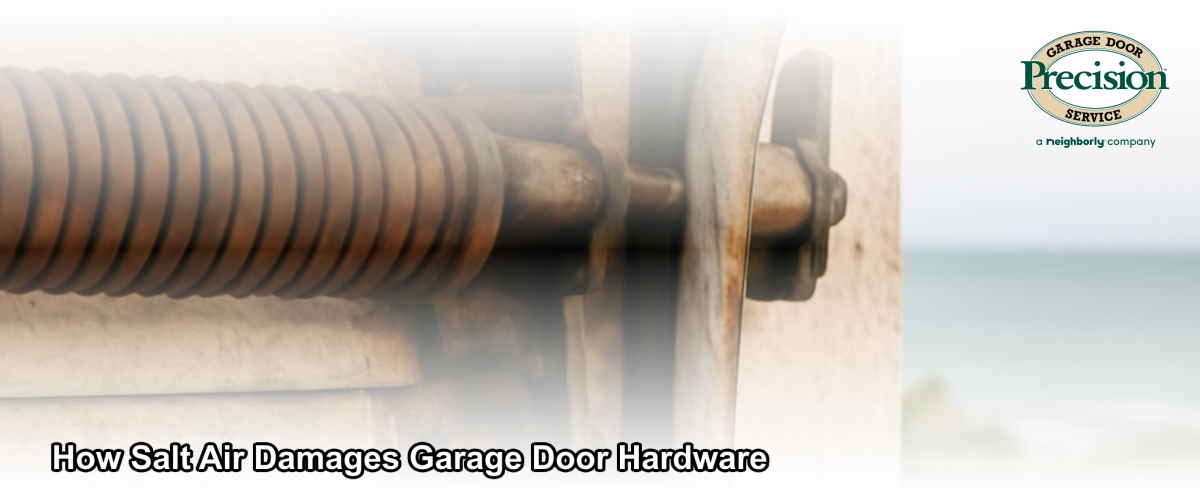
Salt air accelerates metal corrosion on garage door hardware because airborne sodium chloride particles settle on steel and iron surfaces, drawing moisture and triggering an electrochemical reaction that produces rust far faster than in dry inland climates. In Ventura County, homes within a few miles of the Pacific — from the Ventura shoreline west through Oxnard and north toward Rincon — are exposed to this marine layer year-round, not just during storm season. Unlike UV damage or general wear, salt corrosion is invisible at first, eating through protective coatings before any rust is visible to the eye.
Precision Garage Door Ventura serves this coastline daily and consistently finds that hardware on coastal properties fails 30–50% sooner than identical hardware installed at comparable inland homes in the Santa Clara River valley or Moorpark corridor. That difference translates directly into repair calls and, in preventable cases, full hardware replacements that could have been avoided.
Which garage door parts are most vulnerable to salt air corrosion?
Torsion springs, extension springs, and cable drums are the most corrosion-vulnerable components on a coastal garage door because they are high-tension steel parts with large surface areas and no practical way to seal them from the air. Salt infiltrates the coils of a torsion spring, weakens the metal grain structure, and can cause catastrophic failure — a snapped spring under tension is a serious safety hazard, not just a mechanical inconvenience.
Beyond springs, these components degrade fastest in Ventura County’s marine environment:
- Rollers — steel-ball bearing rollers rust at the races and seize, causing jerky, noisy operation and accelerated track wear
- Hinges — the pivot points corrode and crack, reducing panel flexibility and putting stress on surrounding panels
- Bottom brackets and cables — salt pitting weakens cable strands individually before the cable shows visible fraying
- Tracks — galvanized tracks lose their zinc coating faster at the coast, leaving bare steel exposed to salt and moisture
- Opener rail and carriage assembly — often overlooked, the rail above the door accumulates salt dust that drips lubricant and corrodes fasteners
Nylon rollers are significantly more corrosion-resistant than steel rollers and are one of the most cost-effective hardware upgrades for any Ventura County coastal home — as covered in our full roller upgrade guide.
How quickly does salt air damage garage door hardware near the Ventura coast?
In high-exposure coastal zones — typically within 1–2 miles of the Pacific in areas like Ventura’s Pierpont Beach neighborhood or the Oxnard Shores area — untreated steel hardware can show measurable surface corrosion within 6–12 months and functional degradation within 2–3 years. Further inland, toward Highway 101 and beyond, the marine layer still reaches but concentration drops, extending hardware life to closer to the national average of 7–10 years for springs and 10–15 years for tracks.
The critical variable is whether the garage door is used frequently. Every open-and-close cycle ventilates the garage with outside air, pulling in a fresh dose of salt-laden moisture. A household that opens the door 6–8 times per day exposes hardware to significantly more cumulative salt load than a garage opened twice daily — a fact that matters when estimating your hardware’s actual remaining service life.
What are the warning signs that salt air has already damaged my garage door hardware?
The clearest early warning sign is a grinding or squealing sound during operation, which indicates that rollers or hinges have lost lubrication due to corrosion breaking down the grease film. Other signs Precision Garage Door Ventura’s IDEA Certified Residential Technicians look for during service calls in Ventura County include:
- Visible orange or brown rust streaks running down from hinges or tracks onto the door panels
- A door that moves unevenly, jerks, or hesitates partway through its travel
- Visible fraying or discoloration on lift cables
- Torsion spring coils that appear dark, pitted, or have visible gaps when the door is closed
- Tracks that look chalky, white-dusted, or have flaking zinc coating
If you notice any two of these symptoms together, schedule a professional inspection before a single-component failure compounds into multi-part damage. A seized roller, for example, will gouge the track — turning a $20–$40 roller replacement into a much larger track repair.
How can I protect garage door hardware from salt air in Ventura County?
The most effective protection strategy combines the right lubricant, the right hardware materials, and a consistent maintenance schedule timed to Ventura County’s climate patterns. For coastal homes, apply a silicone-based or lithium-based spray lubricant to all moving metal parts — springs, hinges, rollers, and tracks — every 3–4 months rather than the once-a-year schedule often recommended for dry-climate homes. Salt-air environments demand twice the lubrication frequency.
Hardware material choices matter significantly at installation or replacement time:
- Stainless steel or galvanized hardware over standard steel wherever available
- Nylon rollers with sealed bearings instead of open-race steel ball rollers
- Powder-coated or marine-grade zinc-coated tracks for maximum coating durability
- Vinyl or composite bottom seals instead of rubber, which degrades faster in UV-rich coastal sun
Beyond materials, rinsing the exterior of your garage door and the visible hardware with fresh water during or after windy onshore events — common in Ventura County during late fall and winter — removes concentrated salt deposits before they sit overnight and accelerate corrosion.
How much does it cost to repair or replace salt-corroded garage door hardware in Ventura County?
The cost to repair salt-corroded garage door hardware in Ventura County depends on which components have failed, but a targeted repair — replacing springs, cables, and rollers together as a coastal hardening service — typically runs $200–$500 for most residential single-car doors, and $300–$650 for two-car doors, parts and labor included. Waiting until multiple components fail simultaneously can push total repair costs to $700–$1,200 or higher if track replacement becomes necessary.
Individual component benchmarks for context:
- Torsion spring replacement — typically $150–$300 depending on door weight and spring size
- Roller set replacement (all rollers) — typically $80–$180
- Cable replacement (pair) — typically $75–$150
- Full hardware tune-up with lubrication and inspection — typically $75–$150
What’s included and what isn’t: professional hardware service from Precision Garage Door Ventura includes lubricating all moving parts, adjusting spring tension, inspecting cables and bottom brackets, and a safety check of the auto-reverse mechanism. It does not include panel or door replacement, opener electronics, or weatherstripping unless specifically quoted. Ask for a full written estimate before any work begins.
Is this something I can fix myself, or should I hire a professional?
Lubricating your garage door hardware and rinsing down salt deposits are safe, effective DIY tasks that any homeowner can perform on a regular basis. Replacing corroded rollers or hinges is also within reach for a confident DIYer with basic hand tools. However, torsion spring replacement is not a safe DIY project under any circumstances — a torsion spring stores hundreds of foot-pounds of energy and can cause severe injury if released unexpectedly during removal or installation.
Precision Garage Door Ventura’s IDEA Certified Residential Technicians handle torsion spring work exclusively as a professional service, and for good reason — the tooling, training, and winding bar technique required to safely wind and unwind loaded springs are not intuitive and not forgiving of error. Extension springs carry similar risks if the safety cable is not properly installed. For anything beyond lubrication and visual inspection, a professional assessment protects both the homeowner and the hardware.
How often should Ventura County coastal homeowners schedule garage door maintenance?
Coastal homeowners in Ventura County should schedule a professional garage door inspection and service every 6 months, compared to the once-a-year schedule appropriate for homes in drier inland climates. The combination of salt air, marine-layer humidity, and strong seasonal onshore winds that characterize Ventura County’s coastal zone creates compounding stress on hardware that outpaces a standard annual maintenance cycle.
A practical schedule for most coastal Ventura properties: one professional service call in late spring (after the windiest part of the Santa Ana and spring onshore period), one in early fall before the late-season storm window, and a DIY fresh-water rinse and lubrication check every 90 days in between. See our full seasonal maintenance checklist for the complete step-by-step process. Precision Garage Door Ventura serves the entire coastal Ventura County corridor from Ventura and Oxnard south to the Ventura-Los Angeles county line, and offers maintenance scheduling for recurring service customers.
This guide was prepared by Precision Garage Door Ventura’s IDEA Certified Residential Technicians, serving Ventura, Oxnard, and the greater Ventura County coastal corridor.
Frequently Asked Questions
How does living near the Ventura coast affect how often I need garage door service?
Coastal homes in Ventura County should have garage door hardware professionally serviced every 6 months rather than annually. Salt air and marine-layer humidity accelerate corrosion on springs, rollers, and cables significantly faster than dry inland conditions, making twice-yearly inspections the most cost-effective way to prevent premature failures.
What type of lubricant should I use on garage door hardware in a salty coastal environment?
Use a silicone-based or white lithium-based spray lubricant on all moving metal parts, and apply it every 3 to 4 months in coastal Ventura County — not just once a year. Avoid WD-40 as a primary lubricant; it displaces moisture temporarily but does not provide lasting corrosion protection on high-tension hardware like springs and cables.
Can I replace corroded garage door springs myself to save money?
Torsion spring replacement is not safe as a DIY project — loaded torsion springs store hundreds of foot-pounds of energy and require specialized winding bars and professional training to handle safely. Roller and hinge replacement can be done by a confident DIYer, but all spring work should be handled by a certified technician.
How much sooner do garage door parts wear out near the Ventura coast compared to inland?
Hardware on coastal Ventura County properties exposed to direct salt air typically fails 30 to 50 percent sooner than identical hardware installed at comparable inland homes. Springs that might last 10 years in a dry inland climate can show functional degradation in 5 to 7 years — or faster within a mile or two of the ocean.
What is the first thing I should check if my garage door sounds grinding or squealing?
A grinding or squealing garage door usually means rollers or hinges have lost their lubrication — often because salt corrosion has broken down the grease film. Check for visible rust on rollers and hinges first, apply fresh lubricant, and test the door. If the noise persists or the door moves unevenly, schedule a professional inspection before a seized roller causes track damage.